西藏梗
Tibetan Terrier
本条目简介尚在编纂。可先参阅下方博物志,或到手记留下你的经验。
🐾性情
The temperament has been one of the most attractive aspects of the breed since it was established. They are amiable and affectionate family dogs, sensitive to their owners, and gentle with older children if properly introduced. As is fitting for a dog with origins as a watch dog, Tibetans tend to be reserved around strangers, but should never be aggressive or shy with them. The Tibetan Terrier has a deep bark and is prone to excessive barking. While suitable for apartment living, the Tibetan is an energetic dog that requires regular exercise. The energy level of the Tibetan is moderate to high
🌿健康
A 2024 UK study found a life expectancy of 13.8 years for the breed compared to an average of 12.7 for purebreeds and 12 for crossbreeds. Tibetan Terriers can carry the genetic disease canine neuronal ceroid lipofuscinosis, called Batten disease in humans. The first symptom of the disease is night blindness. Blindness and neurological signs such as epilepsy, motor abnormalities, dementia, and unexpected aggression may follow some years later. The gene responsible for the disease in Tibetan Terriers was identified in 2009 and there is a DNA test available for it. A German study showed that abou
👁形貌
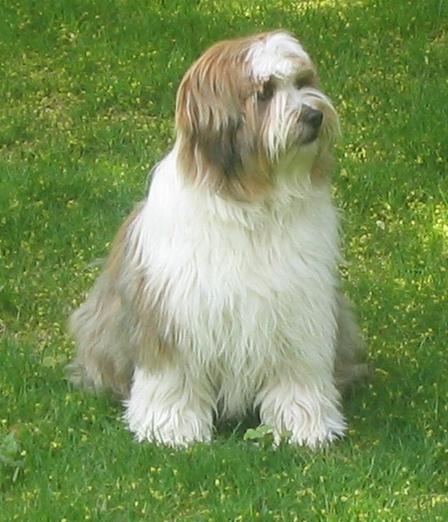
The Tibetan Terrier is a powerful, medium-sized dog of square proportions, with a shaggy coat. They vary widely in height and weight, ranging from 14 to 16 in (35–41 cm) and is 18–30 lb (8–14 kg), with 20–24 lb (9.5–11 kg) preferred for either sex. All weights are acceptable if in proportion to the size. Fully grown, the Tibetan Terrier resembles a miniaturized Bearded Collie. The head is moderate, with a strong muzzle of medium length, and a skull neither rounded nor flat. The eyes are large, dark, and set fairly far apart. The V-shaped drop ears are well-feathered, and should be set high on
📜源流
Tibetan Terriers have been bred and raised in monasteries of Tibet for 2,000 years. Historically, Tibetan Terriers were kept as good luck charms, mascots, watchdogs, herding dogs, and companions. They were also used to retrieve articles that fell down mountainsides. Dr. Agnes Greig of England brought the first Tibetan Terrier to Europe in 1922. She was given a gold and white female puppy named Bunti after successfully performing an operation on a patient in Tibet. After acquiring a second male, Rajah, Dr. Greig established a kennel and began to breed them. The first litter was born in 1924 and